
Chelsey Ryker - Nationwide Boiler Inc. - Boiler Blog Archive | Nationwide Boiler Inc.
Skip to main content

Boiler Blog Archive | Nationwide Boiler Inc.

Nationwide Boiler news and events, industry updates, technical resources and more. You hear it first on The Nationwide Boiler Blog!

At Nationwide Boiler, we’ve spent more than four decades helping industries meet demanding emissions requirements with solutions that deliver reliability, performance, and proven results. Our CataStak™ Selective Catalytic Reduction (SCR) System is one of those solutions—engineered to achieve ultra-low, single-digit NOx emissions on package boilers and a wide range of fired equipment. As air-quality regulations continue to tighten, understanding NOx and the importance of emissions control is more critical than ever.

What Is NOx?

NOx, or nitrogen oxides, represents a group of highly reactive gases formed when nitrogen and oxygen combine during high-temperature combustion. These emissions are common in industrial boilers and fired equipment, including:

  • Package boilers
  • Fired heaters
  • Gas turbines
  • Heat recovery steam generators

The amount of NOx produced depends on several operational factors:

  • Fuel type
  • Burner design
  • Peak combustion temperature
  • System configuration
  • Use of emissions-control technology such as an SCR

Why Reducing NOx Emissions Matters

Once released into the atmosphere, NOx contributes to a series of reactions that impact both environmental quality and human health. Even at low concentrations, these gases can significantly affect regional air quality.

Continue reading

Selecting the right boiler for your facility is more than just a design choice – it directly impacts efficiency, reliability, operating costs, and emissions compliance. Among the most common designs are firetube boilers and watertube boilers, each with unique advantages depending on the application. These boilers can also be classified by pressure (low or high), output (steam or hot water), and steam temperature (saturated or superheated), adding further considerations to the decision-making process.

The following overview outlines the key differences between firetube and watertube boilers to help facility managers, engineers, and plant operators choose the system that best fits their needs.

What is a Firetube Boiler?

A firetube boiler, also known as Scotch Marine boiler, is one of the most traditional and widely used boiler designs. In this system, a large pressure vessel holds water, and tubes carrying hot combustion gases run through the vessel. As the gases pass through these tubes, heat is transferred to the surrounding water, gradually increasing its temperature until it produces either hot water or steam depending on the application. Because the “fire” or combustion gases are inside the tubes, the design is known as a firetube boiler.

Key Advantages:

Continue reading

When selecting an industrial steam boiler, it’s essential to understand the key differences between saturated steam and superheated steam boilers. These two steam classifications play distinct roles across industries, ranging from heating processes to power generation. In this guide, we’ll explore the science behind saturated and superheated steam, advantages and disadvantages of each, and how to determine which type of boiler is best suited for your application.

What Is the Difference Between Saturated Steam and Superheated Steam?

Saturated steam is steam that exists at the boiling point of water and is in equilibrium with liquid water at a given pressure and temperature. It contains moisture and is often referred to as “wet steam.” Saturated steam is produced when water is heated until it begins to vaporize.

Superheated steam, on the other hand, is created by heating saturated steam beyond the boiling point without increasing pressure. Also known as “dry steam,” superheated steam has no moisture content, a lower density, and higher energy content. It remains in a gaseous state even as it cools, which makes it highly effective in certain mechanical and thermodynamic applications.

Common Industries and Applications for Each Steam Type

Continue reading

Reliability and Versatility of Nationwide Boiler’s Rental Fleet

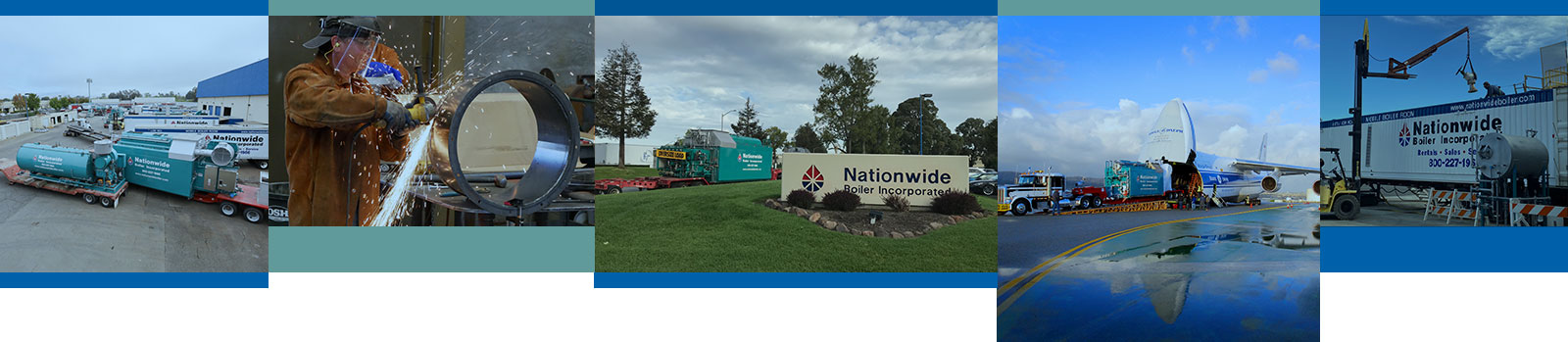
Nationwide Boiler operates and maintains one of the largest and most versatile rental boiler fleets in the industry. Our purpose-built rental inventory includes over 100 temporary boiler systems ranging from 47.5 HP to 200,000 lb/hr, stored in multiple locations across the country. We offer multiple configurations including complete mobile boiler rooms, trailer-mounted watertube and firetube boilers, skid-mounted systems, factory-integrated skid packages, fully electric boiler systems designed for zero-emissions operations, and a suite of boiler auxiliary equipment options. This diverse inventory allows us to respond quickly and effectively to emergency outages, planned maintenance, or increased seasonal demand.

Reliable Steam Solutions for Diverse Industries

One of the key advantages of renting from Nationwide Boiler is our ability to provide fast, reliable steam solutions that are tailored to your application. Whether your facility requires low or high capacity, saturated or superheated steam, boiler-only or a complete temporary steam plant, our rental boiler fleet is engineered to support continuous, dependable operation. Our solutions support a wide range of industries including food processing, petroleum and chemical refining, power generation, pulp and paper, manufacturing, and more.

Maintenance and Refurbishment of Rental Boilers

Continue reading