Recent Blog Posts - Boiler Blog Archive | Nationwide Boiler Inc.
Skip to main content

Boiler Blog Archive | Nationwide Boiler Inc.

Nationwide Boiler news and events, industry updates, technical resources and more. You hear it first on The Nationwide Boiler Blog!

Boiler Procurement, Redefined: Nationwide Boiler Delivers 180,000 PPH In-Stock Boiler to Meet Expedited Procurement Schedule

tbddd
U0A0543SM

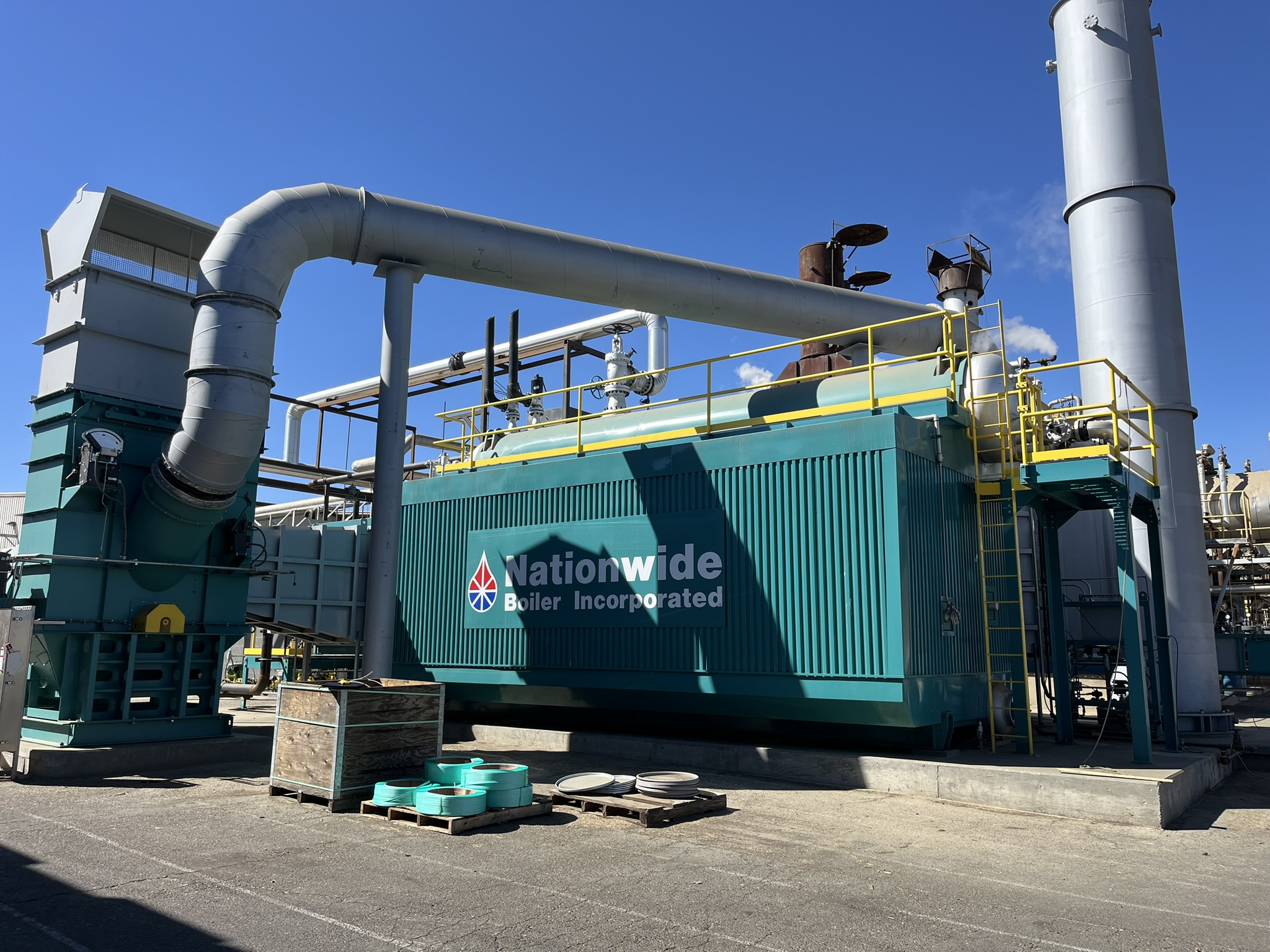
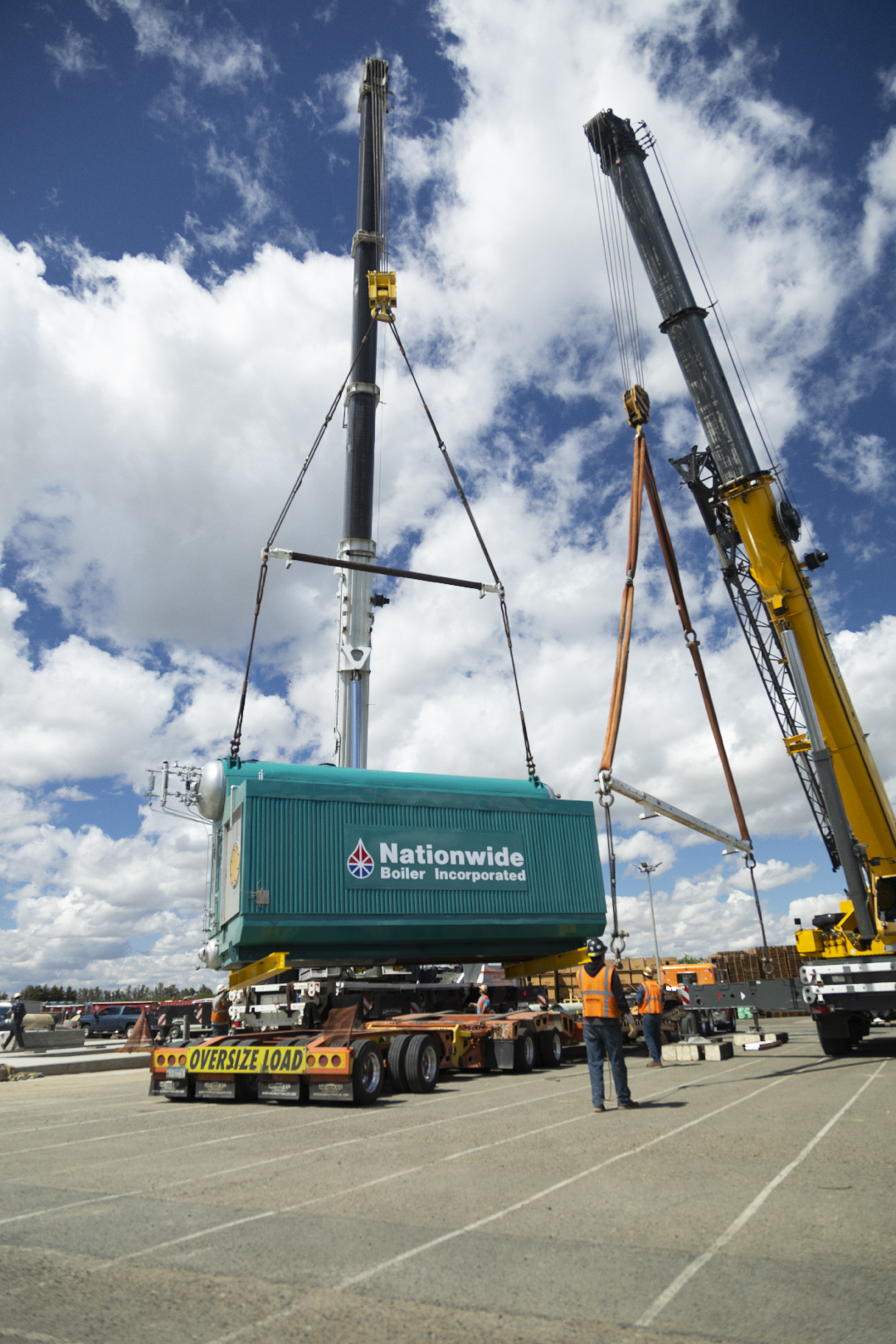
When timing is everything, Nationwide Boiler's in-stock boiler program delivers the solutions today’s industry demands. In 2025, ourteam successfully delivered a fast-track project including a 180,000 lb/hr, 500 psig B&W package watertube boiler with CataStak™ SCR system to a major West Coast food processing plant, overcoming logistical and regulatory challenges to keep production on track.​

This delivery exemplifies our philosophy of “Boiler Procurement, Redefined” — giving customers immediate access to high‑capacity steam without the delays typical of traditional equipment sourcing.

Meeting Urgent Customer Needs with Strategic Boiler Procurement

The project began when a long-term customer faced a critical capacity challenge. As production needs outpaced their older equipment, the prospect of waiting a year for a new boiler was not viable. Thanks to our strategic in-stock boiler program, a high-capacity B&W package watertube boiler was available for immediate shipment, transforming a potential bottleneck into a rapid success story.​

Nationwide Boiler maintains a broad range of in-stock solutions such as this 180,000 lb/hr model, enabling rapid shipping and installation across the United States and globally. Inventory covers everything from compact 50 HP vertical units to large 255,000 lb/hr superheated watertube boilers, including essential ancillary equipment like feedwater systems, blowdown separators, water softeners, and CataStak™ SCR Systems for ultra-low NOx compliance. This diversity enables customers to access rapid replacements or planned upgrades without lengthy lead times and fabrication delays.​

Continue reading
  420 Hits

What Is NOx and Why Does It Matter? Understanding the Impact of Boiler Emissions

At Nationwide Boiler, we’ve spent more than four decades helping industries meet demanding emissions requirements with solutions that deliver reliability, performance, and proven results. Our CataStak™ Selective Catalytic Reduction (SCR) System is one of those solutions—engineered to achieve ultra-low, single-digit NOx emissions on package boilers and a wide range of fired equipment. As air-quality regulations continue to tighten, understanding NOx and the importance of emissions control is more critical than ever.

What Is NOx?

NOx, or nitrogen oxides, represents a group of highly reactive gases formed when nitrogen and oxygen combine during high-temperature combustion. These emissions are common in industrial boilers and fired equipment, including:

  • Package boilers
  • Fired heaters
  • Gas turbines
  • Heat recovery steam generators

The amount of NOx produced depends on several operational factors:

  • Fuel type
  • Burner design
  • Peak combustion temperature
  • System configuration
  • Use of emissions-control technology such as an SCR

Why Reducing NOx Emissions Matters

Once released into the atmosphere, NOx contributes to a series of reactions that impact both environmental quality and human health. Even at low concentrations, these gases can significantly affect regional air quality.

Continue reading
  10918 Hits

Empowering Women, Advancing Industry: Nationwide Boiler at the First Women in Boiler Industry Event

No alternative text description for this image

Celebrating Diversity, Connection, and Leadership in the Boiler Industry

Nationwide Boiler recently participated in the inaugural Women in the Boiler Industry (WIBI) Symposium, held in Minneapolis, MN, on October 15-17th, 2025. Hosted by the American Boiler Manufacturer Association (ABMA), the event joined women and men within the boiler industry to celebrate diversity, foster connections, and advance the future of the boiler industry. Our company proudly sponsored the Welcome Networking Reception for this event, and we were thrilled to have Chelsey Ryker, Director of Marketing & Communications, represent our team.

Bringing together professionals from across North America, the WIBI Symposium was a two-day event full of inspiration and learning. Attendees participated in industry tours, keynote sessions, interactive workshops, and roundtable discussions focused on shaping a more inclusive and dynamic industry. The event included keynotes and fireside chats for building leadership presence and personal mastery, as well as roundtables and panels with trailblazers whose impact is igniting change throughout the boiler community.​ The event also included sessions on boiler code changes, financial management, boosting creativity and productivity through AI, positive communication, and boiler safety.

Nationwide Boiler’s Commitment to Visibility and Advancement

In addition to her participation, Chelsey also served on the WIBI Advisory Committee to help shape the impact of the event. She expressed  the importance of Nationwide Boiler’s support of events like this through a video interview in the weeks leading up to the WIBI Symposium. “Supporting WIBI means we’re investing in visibility, empowerment, and advancement of women in our field,” she noted, underscoring Nationwide Boiler’s dedication to fostering innovation through inclusion. “It’s about creating space for new voices, showing that Nationwide Boiler stands behind the people who are shaping our future.”​

Continue reading
  1173 Hits

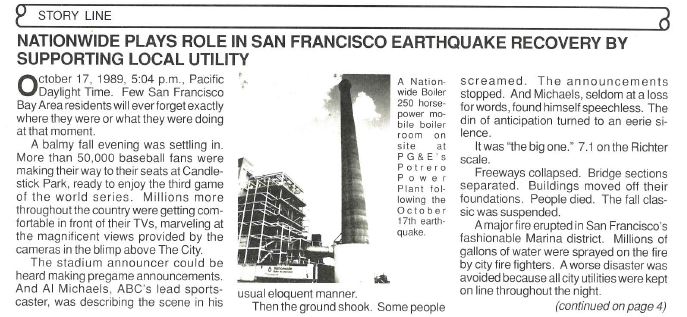
Flashback Friday: Nationwide Boiler Supports San Francisco Earthquake Recovery by Supporting Local Utility

Screenshot 2025 10 13 154712

Let’s take a step back in time to a brisk day in October — a day that became a defining moment in Nationwide Boiler’s history. On October 17, 1989, at exactly 5:04 p.m. Pacific Daylight Time, a powerful 7.1 magnitude earthquake struck Northern California. For residents of the San Francisco Bay Area it was a moment frozen in time, one they would never forget.

It was a calm fall evening. More than 50,000 fans were settling into their seats at Candlestick Park for Game Three of the World Series, while millions more across the country tuned in to the live broadcast. As the stadium announcer provided pregame updates, no one could have anticipated what was about to unfold. Then, the ground began to shake. Screams erupted and the announcements stopped. ABC broadcaster Al Michaels, usually composed and articulate, was momentarily speechless. The energy of the stadium was replaced with an eerie silence. What followed was one of the most significant earthquakes in California’s history: a 7.1 magnitude event that would later be known simply as “the big one.”

In a matter of seconds, freeways collapsed, bridges broke apart, and buildings shifted from their foundations. The World Series was postponed. Fires erupted in multiple areas, including a major blaze in San Francisco’s Marina District, and millions of gallons of water were deployed by first responders to fight the flames. In the midst of widespread devastation, the city narrowly avoided a far worse outcome and utility services remained operational through the night, allowing emergency crews to respond effectively.

At Nationwide Boiler’s office in Fremont, Service Manager Neil McIntosh was still absorbing the shock of the quake. As he cleaned up broken glass and restacked books scattered across the office, he had an uneasy feeling that it would be a long night. And he was right — at 11pm that evening, the facility engineer from PG&E’s Potrero Power Plant, San Francisco’s primary power generation facility, called with a critical issue that could lead to the need for a rental boiler. And the standard question followed: “How fast can you respond?”

In the hours following the earthquake, PG&E engineers struggled to diagnose a serious problem: the plant’s electrically powered feedwater pumps, responsible for supplying water to the boilers that generated steam for turbine operation, had unexpectedly shut down. Under normal conditions, multiple backup systems would prevent any drop in water levels. But in this case, the boilers continued running without feedwater. When the pumps were eventually brought back online, it was already too late. The boilers were dangerously overheated, and it was no longer safe to reintroduce water. In a stopgap effort, a U.S. Navy ship docked next to the power plant was called in to provide emergency steam to cool the boilers. While helpful, this solution was temporary, and the city’s only other power plant was operating at full capacity to meet soaring demand. A failure at Potrero could have led to widespread outages. The only sustainable option was to deploy a high-capacity, fully equipped mobile steam plant that could deliver the right temperature, pressure, and controls to safely restart the system.

Continue reading
  1426 Hits