
steam boilers - Nationwide Boiler Inc. - Boiler Blog Archive | Nationwide Boiler Inc.
Skip to main content

Boiler Blog Archive | Nationwide Boiler Inc.

Nationwide Boiler news and events, industry updates, technical resources and more. You hear it first on The Nationwide Boiler Blog!

Steam: The Most Effective Way to Transfer Heat or Energy

With the COVID-19 pandemic upon us, there has been a lot of talk about essential businesses. What is it that actually deems a business essential? In short, businesses that people rely on in everyday life are essential, while nonessential businesses are generally recreational in nature.

Many consumers may not understand the necessity of steam in everyday life, however, steam plays a major role in many industries including hospitals, food processing, refineries, and pulp and paper manufacturing. Let’s dive into exactly how steam is used in some of these processes.

Hospitals
One of the most obvious groups of essential workers right now are those in a hospital, and steam is utilized extensively in all hospital settings. There are five major uses of steam in a hospital: comfort heating, humidification of air, sterilization of surgical instruments and medical waste, laundry, and food preparation.  

Food Processing
Steam used by food processors commonly falls into two distinct categories: Clean Steam or Utility Steam. Clean Steam, also known as “sanitary” or “culinary” steam, is typically used for direct injection into a product or to clean and sterilize product contact surfaces. Utility Steam, also referred to as “plant” steam, can be used in most applications that do not involve direct contact with food products or the surfaces that the food might contact. It is often utilized to supply energy for heating, cooking, or mechanical work. 

Some other examples of where steam is typically utilized in food processing is the tomato canning process, deodorizing cocoa butter, puffing up cereal, and sanitization of yogurt cups.
Continue reading
  7684 Hits

Watertube Boiler Design: Superior Boiler's DS Type

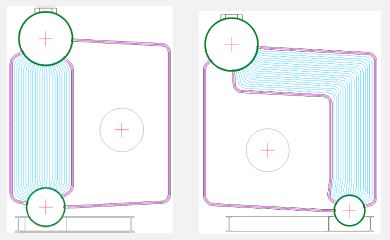
Ds vs Dtype
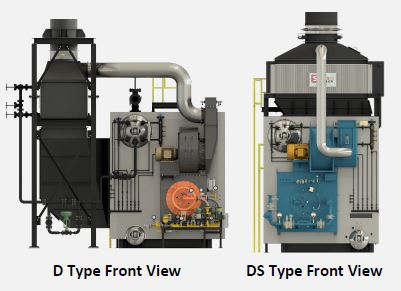
Ds vs Dtype frontview

In our last blog, we reviewed the three common types of watertube boilers: D-Type, O-Type, and A-Type. There is, however, another package watertube boiler on the market today; the Ds-type, providing a fourth option to consider when you are planning for a new boiler. In fact, the Ds-type design is patented and manufactured by Superior Boiler and is one of their most popular watertube boiler models. 

The configuration for this type of boiler is similar to the D-Type, with one upper steam drum, one lower drum, and one convection bank. One of the main differences lies in the convection bank flow area (the bank of tubes that provide convection heat transfer), which is much larger and utilizes upside-down L shaped tubes. This larger area means a reduced boiler pressure drop on the flue gas side. A smaller fan is required, reducing both cost and energy usage.

With Ds-type boilers, the furnace is more centralized and the cross section is more square compared to the rectangular furnace cross section of a D-type boiler. The square shape improves the heat flux from the burner due to walls being more equidistant from the heat source, and with a more uniform heat flux we get improved heat transfer with lower emissions.

Compared to D-type boilers, the Ds-type offers additional features and advantages: 

- Improved shipping and rigging due to a more centralized center of gravity.
- More compact footprint; roughly 1-2ft shorter than typical package boiler. 
- No need for a burner platform since the burner is lower to the ground. 
- The option to be designed with a top exhaust outlet, providing space savings with the ability to mount the economizer in a vertical configuration above the boiler. D-type boilers are limited to a side outlet and horizontal, ground-mounted configuration. 
- An overall lower capital cost caused by fewer transitions and breeching, smaller fan requirement, better heat transfer, and better performance.

Continue reading
  10781 Hits